


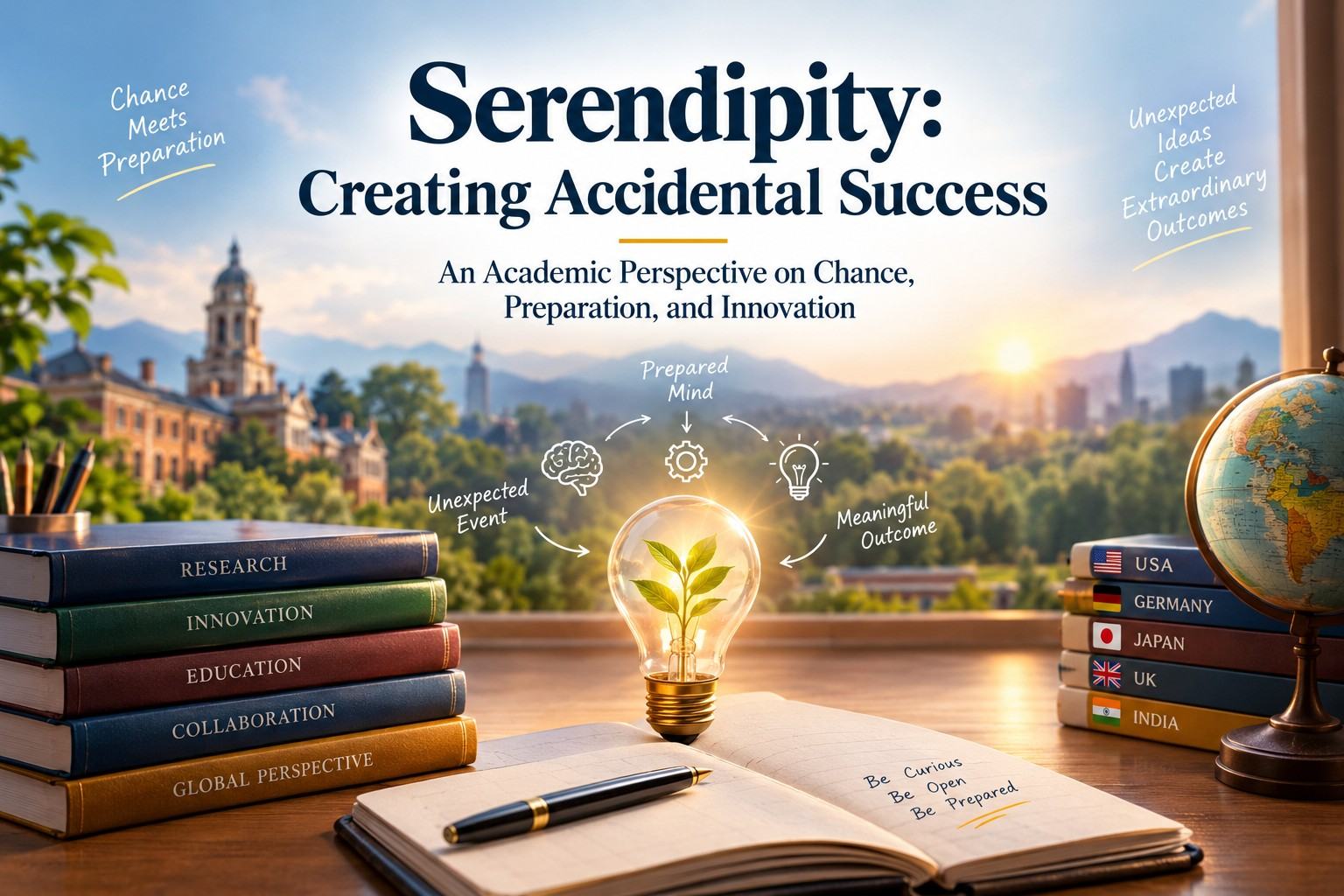
Serendipity: Creating Accidental Success
An Academic Perspective on Chance, Preparation, and Innovation
Serendipity is commonly understood as “luck” or “accidental success.” However, within academic and research literature, serendipity is recognized as a systematic phenomenon, where unplanned discoveries occur when individuals or institutions are prepared, observant, and intellectually flexible. This article examines the origin of the concept of serendipity, its theoretical foundations, and global academic practices, demonstrating how accidental success can be consciously fostered rather than passively awaited.
- 1. Origin and Conceptual Background of Serendipity
The term serendipity originated in the eighteenth century. Its first documented use is attributed to Horace Walpole, who coined the word in 1754 in a personal letter. Walpole referred to the Persian tale The Three Princes of Serendip, in which the protagonists make valuable discoveries not by actively searching for them, but through keen observation, insight, and reasoning.
From an academic standpoint, serendipity does not merely signify a chance encounter. Rather, it is best described as:
“The ability to recognize the value of unexpected information.”
Thus, serendipity represents a combination of randomness and cognition, where chance events become meaningful through intellectual interpretation.
- 2. Serendipity as a Theoretical Construct
Contemporary research conceptualizes serendipity through three core elements:
- Unexpected Event – an outcome or situation that was not part of the original plan
- Prepared Mind – the presence of relevant knowledge, skills, or experience
- Interpretive Ability – the capacity to transform an unexpected event into a meaningful outcome
According to this framework, two individuals may encounter the same accidental event; however, serendipity becomes significant only for the individual who is capable of recognizing and utilizing its value.
- 3. Global Academic Practices: How Countries “Design” Serendipity
3.1 United States: Innovation-Oriented Research Culture
Universities and research institutions in the United States actively promote interdisciplinary collaboration through:
- Open laboratory environments
- Flexible and exploratory research grants
- Cross-domain seminars and innovation hubs
The primary objective is idea collision, where unexpected insights emerge from interactions across disciplines. In this context, serendipity is regarded as a catalyst for innovation rather than mere coincidence.
3.2 Germany: Structured Research Freedom
Germany’s academic model emphasizes rigorous documentation and long-term experimentation:
- Unexpected results are not dismissed
- Research failures are preserved and analyzed as valuable data
Within this system, serendipity emerges as a methodological by-product of disciplined yet open-ended research practices.
3.3 Japan: Kaizen and Observational Learning
In Japanese academic and industrial research, serendipity is closely linked to the philosophy of continuous improvement (Kaizen):
- Minor deviations in processes are carefully observed
- Errors are viewed as potential sources of innovation
This approach demonstrates that discipline and serendipity are not mutually exclusive but can coexist productively.
3.4 United Kingdom: Creative and Interdisciplinary Thinking
In the United Kingdom, serendipity is integrated with creativity and the humanities through:
- Arts–science collaborations
- Think tanks and interdisciplinary research centers
- Liberal and flexible academic curricula
Such environments encourage unexpected theoretical connections and novel perspectives.
- 4.Serendipity in the Indian Academic Context
The Indian education system possesses significant potential for serendipity; however, several challenges remain:
- Curricula are often rigid and examination-oriented
- Failure is frequently perceived as a negative outcome
- Limited emphasis is placed on reflection and documentation
Nevertheless, the growth of startups, research incubators, and reforms driven by the National Education Policy (NEP) are increasingly promoting experimentation and interdisciplinary learning.
- 5.Implications for Higher Education and Research
To effectively leverage serendipity for academic growth, institutions must:
- Design flexible and adaptive curricula
- Provide exploratory freedom within research frameworks
- Treat failure as a legitimate learning outcome rather than a setback
Serendipity is not something to be passively awaited; it must be actively enabled.
Conclusion
From an academic perspective, serendipity is not a random miracle. It is a phenomenon that emerges when chance events interact with prepared and perceptive minds. Societies and institutions that create environments conducive to this interaction are more likely to achieve sustained innovation and long-term success.
Serendipity is not the opposite of planning; it is the reward of intelligent openness.
Dr. Anita Gangrade
Associate Professor Law
IILM-AHL Jaipur Campus