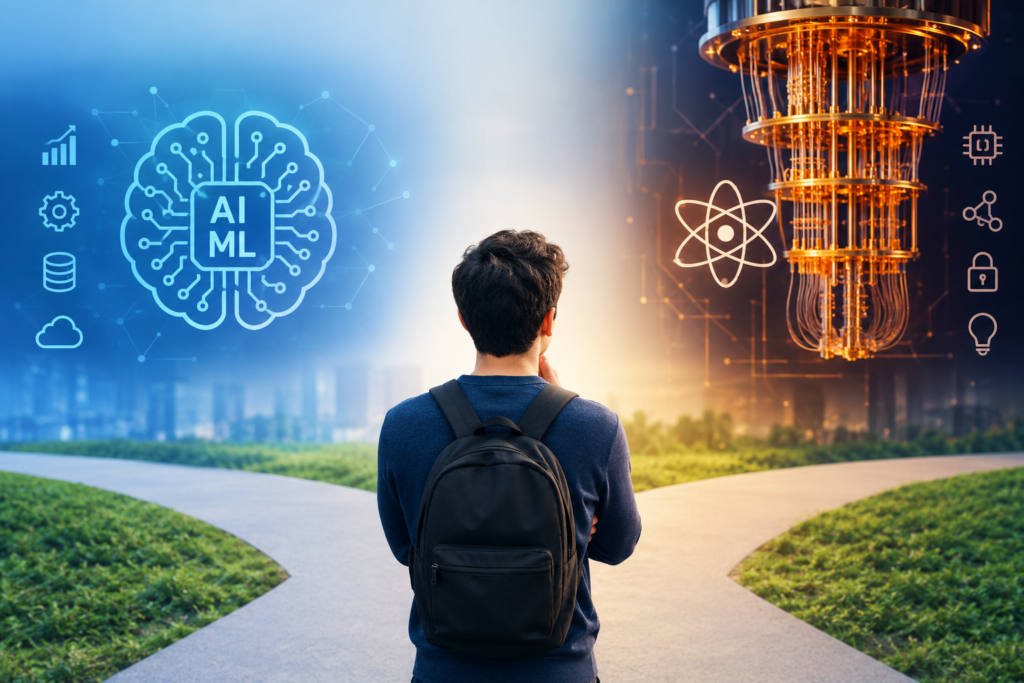
Quick Answer: For most undergraduate engineering students in India in 2026, AI/ML is the safer and more immediately rewarding specialization. It has mature hiring pipelines, established curricula, and thousands of entry level roles. Quantum computing is a genuinely important emerging field, backed by serious government investment, but it currently has very few industry jobs in India, mostly at the research and PhD level. Choose quantum computing only if you are drawn to physics heavy research and are comfortable with a longer, less certain path to employment.
If you are a 12th grade student or an undergraduate choosing a B.Tech specialization, this is a genuinely confusing decision right now, because both fields are described in almost identical marketing language: “the technology of the future,” “massive government investment,” “huge salaries.” The two fields are not actually comparable in terms of where they stand today. One has an established industry with real hiring volume. The other has enormous long term potential and very little current industry demand outside research labs. This article compares them honestly, using current data on funding, job markets, and where each field will realistically be by the time you graduate, so you can make the decision with your eyes open rather than based on which term sounds more futuristic.
Quantum Computing and AI/ML Are Not at the Same Stage of Maturity
The most important thing to understand before comparing salaries or curricula is that AI/ML and quantum computing are not two equally mature options sitting side by side. They are at different points on a technology adoption curve, and that difference should drive your decision more than any other single factor.
AI/ML has moved from research to widespread commercial deployment. Nearly every mid sized and large company in India, across banking, retail, healthcare, manufacturing, and IT services, now has some AI or ML function, even if it is small. Quantum computing, by contrast, is still primarily in the research and government funded infrastructure building stage, both globally and in India specifically. That does not make it a bad field. It makes it a field with a very different risk and timeline profile than AI/ML.
Where AI/ML Stands in 2026
AI adoption in India has moved well past the pilot stage. A 2025 FICCI EY Parthenon survey of 30 leading Indian higher education institutions found that over 60% now let students use AI tools, and separate industry coverage citing the 2025 India Skills Report notes that most entry level roles now require some form of AI linked skill, with freshers who have AI skills earning approximately 56% more than peers without them. Universities have responded accordingly: IILM University, for instance, offers a dedicated B.Tech CSE specialization in Artificial Intelligence and Machine Learning, built around AI fundamentals, deep learning, and applications of ML in industry, alongside a separate B.Tech in Artificial Intelligence programme and a postgraduate M.Tech in Generative AI for students who want to specialise further after their bachelor’s degree.
Where Quantum Computing Stands in 2026
Quantum computing in India is at a much earlier stage, and it is worth being precise about what that means rather than treating it as simply “less popular.” The Union Cabinet approved India’s National Quantum Mission on April 19, 2023, with a budget of ₹6,003.65 crore (approximately $730 million) spanning 2023 to 24 through 2030 to 31. The mission’s own stated targets are technical infrastructure milestones, not job creation numbers: intermediate scale quantum computers with 20 to 50 physical qubits within 3 years, 50 to 100 qubits within 5 years, and 50 to 1,000 qubits within 8 years. In other words, the government’s own roadmap describes 2026 as still being in the early to middle phase of building the hardware itself, years before an industry job market comparable to AI/ML’s could realistically exist at scale in India.
Globally, a small number of universities have started offering dedicated undergraduate quantum computing specializations, including Amrita Vishwa Vidyapeetham and Manav Rachna University, and CGC University in Mohali runs an IBM backed quantum computing B.Tech track. As of this writing, IILM does not offer a dedicated quantum computing specialization within its B.Tech programmes; its School of Computer Science and Engineering instead concentrates on AI/ML, robotics, cybersecurity, cloud computing, and data science tracks. That is a useful, honest data point in itself: quantum computing specializations remain rare enough in India that most universities, IILM included, have chosen to build depth in AI/ML and adjacent fields first, rather than launch a quantum programme before the surrounding industry and faculty ecosystem exists to support it.
Job Market Comparison: What the Data Actually Shows
This is the section prospective students most need and most rarely get a straight answer on. Here is the honest comparison, side by side.
| Factor | AI/ML | Quantum Computing |
| Current industry job volume in India | Very high, across IT services, product companies, banking, and startups | Very low, mostly research labs, a handful of startups, and academia |
| Typical entry point | B.Tech, or even a strong portfolio without a specialised degree, is often enough | Usually requires a master’s or PhD in physics, mathematics, or a quantum specific programme |
| Global talent gap | Present, but narrowing as more graduates enter the field each year | Severe: McKinsey’s global research found only 1 qualified candidate for every 3 quantum job openings |
| Government investment (India) | Multiple initiatives under the IndiaAI Mission, alongside private sector investment | ₹6,003.65 crore National Quantum Mission (2023 to 2031), focused on infrastructure and research, not yet job creation at scale |
| Time to first job after degree | Immediate for most graduates with reasonable skills | Often requires postgraduate study first, especially for research or hardware roles |
| Risk if the field does not grow as expected | Low. AI/ML is already embedded in normal business operations | Higher. Quantum computing’s commercial timeline still depends on unresolved hardware breakthroughs |
The Quantum Talent Gap Is Real, But It Cuts Both Ways
A 2023 McKinsey analysis found that globally, there is only about one qualified quantum candidate for every three open quantum job postings, and predicted that less than half of quantum computing jobs would be filled by 2025 without significant intervention. This statistic gets used constantly in quantum computing marketing material as proof of huge opportunity, and it is true that specialised quantum talent is scarce. But it cuts both ways: the reason so few candidates are qualified is that the total number of quantum specific jobs is still small in absolute terms, concentrated heavily in a handful of countries, research institutions, and large technology companies, and the qualification bar (often a physics or applied mathematics PhD) is far higher than for a typical AI/ML role. A talent gap in a market of 5,000 global jobs is a very different opportunity than a talent gap in a market of 500,000 jobs, and AI/ML sits much closer to the latter.
What This Means If You Are Choosing Right Now
If your goal is to get hired within a year or two of graduating with a bachelor’s degree, AI/ML gives you a far higher probability of success in the Indian job market as it exists today. If your goal is a long term research career, you are genuinely excited by physics and mathematics, and you are prepared to pursue a master’s or doctorate before entering the workforce, quantum computing is a legitimate and forward looking choice, but it should be approached as a research path, not a fast track to an engineering job.
Curriculum Differences: What You Will Actually Study
Beyond job prospects, the two fields also demand very different aptitudes, and this should factor into your decision as much as employability data.
AI/ML Curriculum, Typically Covers
- Python programming and software engineering fundamentals
- Statistics, linear algebra, and calculus, applied rather than theoretical
- Machine learning algorithms: regression, classification, clustering
- Deep learning and neural network architectures
- Natural language processing and computer vision
- MLOps and deployment of models into real applications
A programme like IILM’s B.Tech CSE with specialization in AI and Machine Learning reflects this structure directly, moving from AI fundamentals and introductory machine learning toward deep learning, natural language processing, and applied industry projects across a four year degree.
Quantum Computing Curriculum, Typically Covers
- Quantum mechanics fundamentals: superposition, entanglement, decoherence
- Linear algebra at a much deeper theoretical level than most AI/ML courses require
- Quantum algorithms (Shor’s algorithm, Grover’s algorithm, and others)
- Qubit architectures and quantum hardware platforms (superconducting, photonic, trapped ion)
- Quantum programming frameworks such as IBM’s Qiskit or Google’s Cirq
- Quantum cryptography and post quantum security
The honest difference here is that quantum computing leans much more heavily on physics and abstract mathematics than most engineering students expect when they first hear “computing” in the name. Students who found their 12th grade physics and mathematics genuinely enjoyable, not just manageable, tend to do better in quantum programmes than students who are drawn to the field purely because it sounds cutting edge.
Salary Expectations: A Realistic Picture
Salary comparisons between these two fields are frequently misleading online, because global quantum salary figures (often quoted in dollars or Swiss francs from US and European postings) get compared directly against Indian AI/ML fresher salaries, which makes quantum computing look dramatically more lucrative than it currently is for an Indian graduate.
A more honest comparison looks like this:
| Role | Typical Entry Point | Approx. Indian Market Reality in 2026 |
| AI/ML Engineer (fresher) | B.Tech in CSE, AI/ML, or related field | Widely available roles, competitive but realistic entry salaries, with rapid growth for strong performers within a few years |
| Data Scientist | B.Tech plus some ML specialisation or a relevant master’s | Strong demand across sectors, with salary progression tied closely to demonstrated project work |
| Quantum Software Developer or Research Assistant | Usually a master’s or PhD in physics, quantum computing, or a closely related field | A small number of roles, concentrated in research institutions, a handful of Indian and multinational quantum startups, and PhD linked positions; high specialised pay where roles exist, but far fewer roles overall |
The practical takeaway: quantum computing salaries can be excellent for the small number of highly specialised roles that exist, particularly abroad, but a fresh engineering graduate in India is statistically far more likely to land a well paying AI/ML role within their first year than a quantum computing role of similar seniority.
Who Should Actually Choose Quantum Computing
Despite everything above, quantum computing is not a bad choice for the right student. It makes sense if most of the following are true for you:
- You plan to pursue a master’s degree or PhD rather than entering the workforce immediately after a bachelor’s degree
- You genuinely enjoyed physics and advanced mathematics in school, not just tolerated them
- You are interested in research, academia, or a long term career at a national lab, research institute, or a company’s advanced R&D division
- You are comfortable with career uncertainty in exchange for being an early specialist in a field that could be transformative a decade from now
- You have access to, or are willing to relocate for, one of the small number of strong quantum programmes and research hubs, several of which in India are anchored at IITs and IISc under the National Quantum Mission’s hub and spoke model
Who Should Choose AI/ML Instead
AI/ML is the stronger choice if most of the following describe you:
- You want to be employable relatively quickly after a bachelor’s degree, without necessarily committing to further postgraduate study first
- You are comfortable with applied mathematics and statistics but are not specifically drawn to theoretical physics
- You want to work across a wide range of industries rather than a narrow research niche, since AI/ML skills now apply to finance, healthcare, retail, manufacturing, and government alike
- You want your specialization to be reinforced by strong industry partnerships and placement pipelines while you are still studying, which is where programmes like IILM’s B.Tech CSE AI/ML track and its broader B.Tech CSE placement outcomes are relevant to look at directly
A Middle Path: You Do Not Have to Choose Blindly Right Now
One point rarely made clearly in this debate: for most undergraduate students, this is not a binary, irreversible choice made at age 17 or 18. A student who specializes in AI/ML at the bachelor’s level keeps quantum computing genuinely open as a postgraduate option, since strong mathematics and programming foundations from an AI/ML degree transfer reasonably well into a quantum computing master’s, particularly on the software and algorithms side rather than the hardware side. The reverse is less true. A narrow undergraduate quantum specialization, if the field’s commercial timeline moves slower than expected, transfers less cleanly into the broader software and AI job market, since much of the coursework is quantum specific rather than general purpose programming and machine learning.
This asymmetry is worth taking seriously. If you are genuinely unsure which path excites you more, choosing AI/ML at the undergraduate level and exploring quantum computing through electives, research projects, or a postgraduate specialisation later, such as IILM’s M.Tech in Generative AI or a dedicated quantum master’s elsewhere once you have more clarity, is generally the lower risk sequencing.
FAQs
Is quantum computing better paid than AI/ML in India?
Not in practice, for most graduates, at least not yet. A small number of highly specialised quantum roles, often requiring a PhD and often based abroad, can pay very well. But the typical Indian AI/ML fresher has access to far more job openings overall, which matters more than a theoretical top end salary you are unlikely to reach without years of additional study.
Will quantum computing replace AI/ML?
No, and this framing is misleading. The two fields solve different kinds of problems. Quantum computing is expected to eventually accelerate certain narrow classes of computation, such as optimisation and cryptography, while AI/ML continues to handle pattern recognition, prediction, and generative tasks. Many experts expect the two fields to increasingly work together, with quantum hardware eventually accelerating certain machine learning workloads, rather than one replacing the other.
Can I switch from AI/ML to quantum computing later?
Yes, more easily than the reverse. A strong foundation in linear algebra, probability, and programming from an AI/ML degree is a reasonable launching point for a quantum computing master’s degree, particularly for quantum software and algorithms roles rather than hardware engineering roles, which usually require a physics or electrical engineering background from the undergraduate level.
Does IILM University offer a quantum computing specialization?
As of this writing, IILM’s School of Computer Science and Engineering offers specializations in AI/ML, cybersecurity, cloud computing, data science, and robotics, rather than a dedicated quantum computing track. Students interested in quantum computing at the undergraduate level in India currently have more direct options through the small number of universities that have launched dedicated programmes, though this landscape is likely to expand as India’s National Quantum Mission matures.
Is it too early to specialise in quantum computing at all?
Not too early to learn about it, but likely too early for most students to bet an entire undergraduate specialization on it if quick employability is the goal. A more balanced approach for a curious student is to specialise in AI/ML or core computer science at the undergraduate level, then evaluate quantum computing seriously at the postgraduate stage, once the National Quantum Mission’s infrastructure and the resulting job market have had a few more years to develop.
What if I want to work in quantum computing research specifically, not industry?
If academic or government research is your actual goal rather than industry employment, the calculation changes. Research careers value early specialization more than industry roles do, and a focused quantum computing background pursued through a strong physics or engineering undergraduate degree, followed by a master’s or PhD at one of the National Quantum Mission’s hub institutions, is a reasonable and legitimate path.
Bottom Line
Quantum computing and AI/ML are not competing options at the same stage of development, and treating them as an even choice is where most students go wrong. AI/ML is a mature, high volume, immediately employable field in India today, backed by real industry partnerships and established B.Tech curricula. Quantum computing is a genuinely important, well funded, long term bet, but as of 2026 it remains primarily a research and postgraduate path in India rather than an undergraduate route to a quick, well paying engineering job. Unless you are specifically drawn to physics heavy research and are prepared to study well beyond a bachelor’s degree, choose AI/ML for your undergraduate specialization, and treat quantum computing as something to explore seriously later, once both you and the industry around it have had more time to mature.