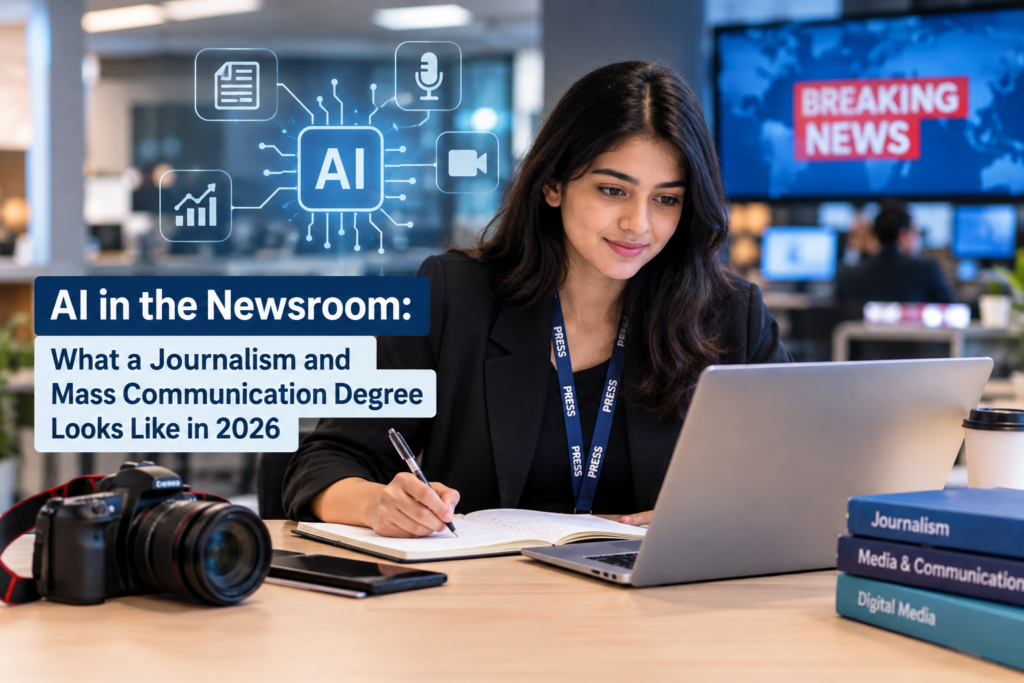
A journalism and mass communication degree in 2026 no longer trains students to simply report, write, and edit. It trains them to do all of that alongside AI tools that draft summaries, generate visuals, transcribe interviews, and even anchor bulletins, while still holding the line on accuracy, sourcing, and editorial judgment that no algorithm can be trusted with. The core discipline, asking good questions, verifying facts, and telling a clear story, has not changed. What has changed is the toolkit around it, and any programme that has not rebuilt its curriculum to reflect that is preparing students for a newsroom that no longer exists.
Quick Answer: A journalism and mass communication degree in 2026 combines traditional reporting, writing, and ethics training with hands on AI skills such as prompt based research, AI assisted editing, data visualisation, and understanding tools like ChatGPT and AI anchors. Programmes now emphasise verification and media literacy even more heavily, since AI has made misinformation cheaper to produce and harder for audiences to detect.
How AI Has Changed the Newsroom Journalists Are Entering
The scale of change in the news industry over the past two years is not a matter of opinion. The Reuters Institute for the Study of Journalism at the University of Oxford surveyed 280 news executives across 51 countries for its Journalism, Media, and Technology Trends and Predictions 2026 report, published in January 2026, and the findings describe an industry under real pressure. Publishers expect search referral traffic to fall by approximately 43 percent over the next three years, and Google search traffic to news sites has already dropped by roughly 33 percent globally, with Google Discover traffic down about 21 percent, largely because AI powered answer engines now summarise news directly rather than sending readers to the original source.
The same report found that AI’s impact on newsroom jobs so far is more limited than headlines suggest. Approximately 67 percent of surveyed news leaders said they had not saved any jobs as a result of AI efficiencies, while 16 percent had slightly reduced staff numbers and 9 percent had actually added new roles and costs tied to AI adoption. This matters for students choosing a journalism degree today: the immediate risk is not mass job losses, but a fast reshaping of what a reporter, editor, or producer’s daily tasks look like.
What a Journalism and Mass Communication Degree Covers in 2026
Core Journalism Skills That Have Not Changed
Every credible journalism programme still centres on the same fundamentals, because AI has not reduced the need for them, it has raised the stakes on getting them right:
- Reporting and interviewing technique, including how to ask follow up questions AI cannot anticipate
- News writing across print, broadcast, and digital formats
- Media law and ethics, including defamation, privacy, and source protection
- Editing for accuracy, clarity, and structure
- Understanding of how media shapes public opinion, democracy, and social welfare
New AI and Digital Skills Now Built Into the Curriculum
What sits alongside those fundamentals has expanded considerably. Modern programmes now typically include:
- Prompt writing and AI assisted research, including how to use generative tools without letting them replace original reporting
- AI content verification and detecting synthetic media, including deepfakes and AI generated images
- Data journalism and basic data visualisation
- Familiarity with AI anchors and virtual presenters, an area growing quickly across Indian broadcast newsrooms
- Understanding of how AI powered platforms and chatbots now mediate how audiences discover news
Inside an AI Integrated Curriculum: What Students Actually Learn
The table below shows how a traditional journalism skill typically maps to its AI augmented version in a current curriculum.
| Traditional Skill | AI Augmented Version Taught Today |
| Manual transcription of interviews | AI powered transcription tools, with manual verification for accuracy |
| Writing a news summary from a press release | Using generative AI for a first draft, then editing for accuracy and voice |
| Static infographics for print | AI assisted data visualisation and interactive digital graphics |
| Studio anchoring only by a human presenter | Understanding AI anchors and virtual presenters, including their limits |
| Manual fact checking against one or two sources | AI assisted cross referencing, paired with human verification as the final check |
| Single language reporting | AI supported multilingual content adaptation for wider audience reach |
Tools Journalism Students Are Expected to Know
Employers increasingly expect journalism graduates to walk in already comfortable with a working set of software and AI tools, not to learn them from scratch on the job. A typical current toolkit includes:
- Editing and production software, such as Adobe Premiere Pro, After Effects, and Final Cut Pro for video, and InDesign and Photoshop for print and digital layout
- Broadcast equipment familiarity, including vision mixers, teleprompters, and production control room workflows
- Generative AI tools, such as ChatGPT for research and drafting support, AI image tools for visual content, and AI voice or avatar tools used in some newsroom experiments with synthetic presenters
- Basic data tools, for cleaning and visualising datasets behind data driven stories
At IILM University, for example, the BA Hons Journalism and Mass Communication programme trains students on a multimedia studio built with NDTV, using a three camera setup, production control room, vision mixer, and teleprompter, alongside AI tools including ChatGPT, Suno, Leonardo, and D-ID, so that the AI literacy is built into the same coursework as traditional broadcast skills rather than taught as a separate add on module.
Career Paths After a Journalism and Mass Communication Degree in 2026
The degree continues to open a wide spread of roles, and AI has added a few new ones to the list rather than replacing the old ones outright:
- Reporter or correspondent, across print, television, or digital newsrooms
- News anchor or presenter, increasingly working alongside AI generated graphics and summaries in the production process
- Digital content producer, creating short form video and social first news content
- Public relations and corporate communication specialist, managing brand messaging and crisis communication
- AI news product roles, an emerging category focused on how AI tools, chatbots, and summarisation features are integrated into a newsroom’s own platforms
- Fact checking and verification specialist, a role growing in direct response to the spread of AI generated misinformation
Students weighing postgraduate options can also look at the MA Mass Communication programme, which builds on undergraduate training with deeper focus on media strategy, digital storytelling, and corporate communication for those aiming at senior editorial or communications roles.
The Trust Problem: Why Ethics Training Matters More Than Ever
Audience trust in news is at a historically low point, and this is precisely the environment today’s journalism graduates are entering. The Reuters Institute Digital News Report 2026 found that trust in news has fallen to its lowest level since the institute began tracking the metric more than a decade ago, with only approximately 37 percent of respondents globally saying they trust most news most of the time. In India specifically, trust sits close to that global figure at approximately 39 percent, and separate findings from the same report show that 58 percent of Indian respondents expressed concern about fake news and misinformation online, a proportion notably higher than in many other markets surveyed.
This is also why India’s chatbot usage for news stands out. The same report found that approximately 22 percent of Indian respondents use AI chatbots to access news, more than double the global average of 10 percent. That gap places extra weight on journalism education to teach not just how to use AI tools, but how to think critically about what those tools get wrong, since a generation of readers is already forming news habits around them.
How Indian Newsrooms Are Actually Using AI Right Now
Indian journalism education is responding to this shift directly, not just in theory. Google’s News Initiative, working with the Indian Institute of Mass Communication, launched an AI Skills Academy in 2025 as a ten week hybrid training programme aimed at newsroom staff and media educators across six Indian cities, teaching practical use of tools such as NotebookLM, Gemini, AI Studio, and Pinpoint for tasks ranging from research to fact verification. IIMC has since expanded this work through its own AI academy for media and entertainment, which had trained more than 110 newsroom professionals as of mid 2026, alongside public statements from India’s Information and Broadcasting Secretary stressing that editorial responsibility and human judgement must remain central even as AI adoption grows.
University level programmes are tracking this same shift closely. At IILM, Associate Dean Bhavneet Singh Aurora, who previously held senior digital roles at the India Today Group, The Indian Express, and NDTV, is currently pursuing doctoral research specifically on the impact of AI tools inside digital newsrooms in India, a sign that the faculty shaping the curriculum are studying the same transition their students will graduate into, rather than teaching it from the outside.
Skills Employers Look For Beyond the Classroom
Recruiters at media houses, PR agencies, and digital content teams consistently look for a few things that a transcript alone cannot show:
- A portfolio of published or produced work, not just coursework assignments
- Demonstrated judgment about when to use AI assistance and when a story genuinely needs original, on the ground reporting
- Comfort working across formats: text, video, audio, and social
- Basic understanding of media law, since AI generated content raises new questions around defamation and copyright that graduates will be expected to navigate
- Internship experience at an actual publication, broadcaster, or agency, which is why placement quality matters as much as classroom content when comparing programmes
How IILM’s Journalism and Mass Communication Programme Is Built for This Shift
IILM’s Department of Communication is led by Nidhi Razdan, formerly Executive Editor at NDTV and an Associate Professor at Harvard University before returning to lead journalism education in India, alongside faculty with direct industry backgrounds in political reporting, television, and digital media. The university states that nearly 60 percent of its courses now integrate AI tools in some form, an initiative led through IILM’s Centre for Excellence in AI and Metaverse, which is intended to give journalism students hands on exposure to AI driven media simulations rather than treating AI as a single standalone subject.
Students can review the full undergraduate structure through the BA Hons Journalism and Mass Communication programme page, which also lists internship partnerships with media houses, PR agencies, and corporate communication firms, along with visits to newsrooms, broadcast studios, and institutions such as the Parliament of India. For a broader view of technology and communication programmes across IILM, the Undergraduate Programme page lists the full range of schools, and the Placement page has details on recruiters across the university.
Common Mistakes Journalism Students Make With AI
- Treating AI generated drafts as finished copy rather than a starting point that still needs verification and a human voice
- Not disclosing AI assistance where a publication’s editorial policy requires it
- Over relying on chatbot summaries of source material instead of reading original documents
- Assuming AI detection tools for deepfakes and synthetic media are fully reliable, when in practice they still require human judgement
- Building a portfolio entirely from AI assisted writing samples, which does little to demonstrate original reporting ability to an employer
Frequently Asked Questions
Will AI replace journalists in the near future?
Current industry data does not support that conclusion. The Reuters Institute’s 2026 survey of news executives found that approximately 67 percent had not saved any jobs through AI efficiencies so far, suggesting AI is reshaping daily tasks more than it is replacing roles outright, at least for now.
Do journalism students need to learn coding or data skills?
Basic data literacy, including simple spreadsheet analysis and data visualisation, is increasingly useful and is now built into many programmes, but advanced coding is not typically a requirement for a journalism and mass communication degree.
Is it still worth studying journalism given falling trust in news media?
Yes, arguably more so. Lower audience trust and the spread of AI generated misinformation increase demand for journalists who can verify information rigorously and explain complex stories clearly, which are exactly the skills a good journalism programme still centres on.
What is the difference between journalism and mass communication as a degree?
Journalism typically focuses on news reporting, writing, and editorial work, while mass communication is broader, covering advertising, public relations, and corporate communication alongside journalism. Most Indian undergraduate programmes, including IILM’s, now combine both under one degree with specialisation tracks in the later years.
Can I work in public relations or corporate communication after a journalism degree?
Yes, this is one of the most common alternate career paths, since the core skills of clear writing, media understanding, and audience awareness transfer directly into public relations, brand communication, and corporate messaging roles.
Bottom Line
A journalism and mass communication degree in 2026 has not abandoned its core purpose, it has simply expanded the toolkit needed to fulfil it. Reporting, verification, ethics, and clear storytelling remain the foundation, but AI literacy, from using generative tools responsibly to recognising synthetic media, is now a built in part of the curriculum rather than an optional extra. With audience trust in news at its lowest recorded level and AI reshaping how people discover information, the graduates who will do well are the ones trained to use these tools critically, not the ones who avoid them or the ones who rely on them uncritically. Choosing a programme that treats AI as embedded coursework, backed by real newsroom infrastructure and faculty who understand the industry from the inside, matters more for a journalism career today than it did even five years ago.