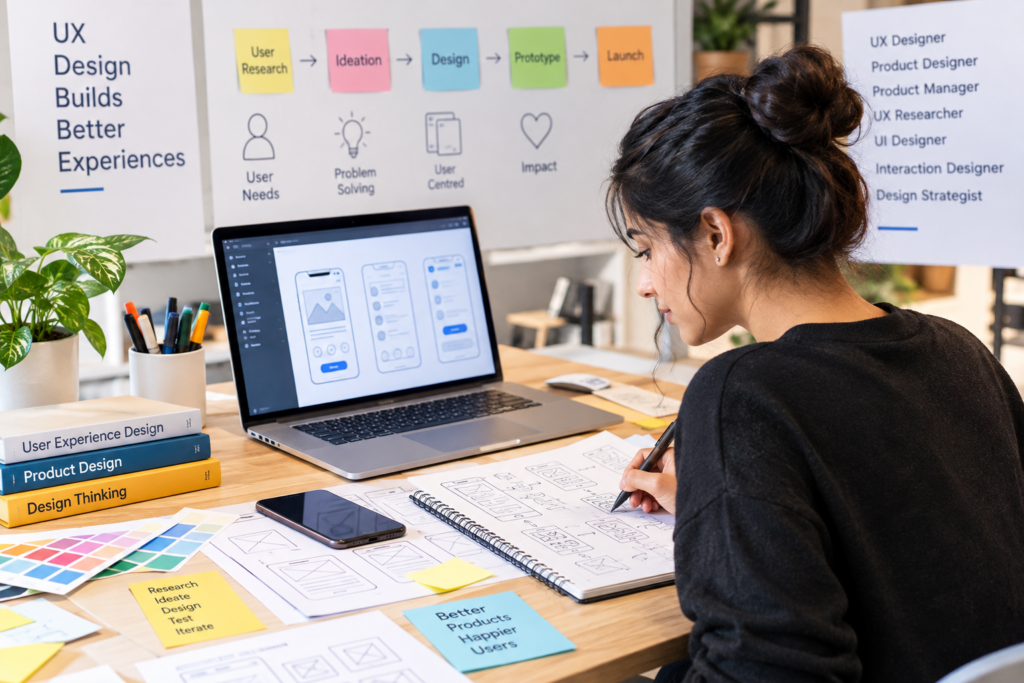
A Bachelor of Design does not put you into a single job title. It opens a spread of related careers such as UX designer, UI designer, product designer, interaction designer, and design researcher, and the specific role you land depends more on your portfolio and specialisation than on the degree name alone. In India, this spread has widened considerably as banks, retailers, healthcare platforms, and consumer apps all compete on how their products feel to use, not just what they do. A B.Des graduate today can move into a pure digital UX role, a physical product design studio, or a hybrid design and business role, often within the same first two years of work.
Quick Answer: After a B.Des in India, graduates typically move into UX designer, UI designer, product designer, interaction designer, or design researcher roles. Entry level pay generally falls between approximately INR 3 and 6 lakh a year, rising to approximately INR 10 to 22 lakh for experienced UX and product designers. Your specialisation, portfolio quality, and software fluency in tools such as Figma matter more than the degree title itself.
What a B.Des Actually Prepares You For
A B.Des programme is built around design thinking, not a single tool or software package. Over four years, students typically move through a common foundation year covering drawing, materials, and design fundamentals, followed by a specialisation such as digital product design, physical product design, interior design, or fashion design. What carries across every specialisation, and what recruiters actually test for, is the ability to research a real user problem, generate multiple concepts, prototype quickly, and defend design decisions with reasoning rather than personal taste.
This is also why the line between UX design and product design has blurred inside most B.Des programmes in India. A single specialisation such as B Design in Digital Product Design now typically covers UX and UI, interaction design, physical product design, and even game design and advanced prototyping under one umbrella, reflecting how design teams are actually structured inside product companies.
Career Paths Open to B.Des Graduates in India
UX and UI Design Roles
These are the most common first jobs for digital product design graduates. A UX designer focuses on research, information architecture, and how a product’s flow feels to a user. A UI designer focuses on the visual layer, typography, colour, and interface consistency. In practice, many entry level roles in Indian startups combine both under a single “UX/UI Designer” title, since smaller teams cannot yet afford to split the function.
Product Design Roles, Physical and Digital
Product design splits into two distinct tracks that a B.Des with a product design specialisation can enter. Digital product designers work on apps, dashboards, and software interfaces, usually inside technology or fintech companies. Physical product designers work on consumer goods, furniture, packaging, and industrial products, usually inside manufacturing, consumer durables, or design consultancy firms. Both tracks share the same underlying process of user research, prototyping, and iteration, just applied to different materials.
Adjacent Roles You Might Not Have Considered
Design graduates increasingly move into roles that sit just outside the traditional design job title:
- UX Researcher, focused purely on interviews, usability testing, and data rather than visual output
- Service Designer, mapping entire customer journeys across digital and physical touchpoints, common in banking and healthcare
- DesignOps Coordinator, managing design systems, tools, and workflow across larger design teams
- Design Entrepreneur, building a studio or product of their own, often supported by business electives taken during the degree
- Front End Developer, for graduates who picked up HTML, CSS, and basic scripting alongside design tools
Skills That Matter More Than Your Specialisation
Recruiters hiring for UX and product design roles in India consistently look past the degree label toward a specific skill set:
- Fluency in Figma, and familiarity with Adobe XD or Sketch as secondary tools
- A portfolio with four to six real case studies, each showing the problem, process, and outcome, not just final screens
- Basic user research methods: interviews, usability testing, and journey mapping
- An understanding of design systems and accessibility, since most product teams now build against a shared component library
- The ability to present and defend a design decision clearly in a review, since design work is judged as much in conversation as on screen
B.Des Specialisations and How They Map to Careers
| B.Des Specialisation | Core Focus | Typical First Roles | At IILM |
| Digital Product Design | UX/UI, interaction design, prototyping | UX Designer, UI Designer, Interaction Designer, Product Designer | B Design in Digital Product Design |
| Product Design (Physical) | Industrial design, ergonomics, materials | Product Designer, Industrial Designer, Packaging Designer | Product Design specialisation, School of Design |
| Interior Design | Space planning, furniture, building services | Interior Designer, Design Consultant, Space Planner | Interior Design specialisation, School of Design |
| Fashion Design and Management | Apparel design, styling, retail | Fashion Designer, Fashion Technologist, Digital Fashion Specialist | Fashion Design and Management specialisation |
Graduates who want to add a business layer on top of a design foundation, particularly for roles in luxury retail, brand strategy, or design leadership, can also look at postgraduate options such as the MA in Luxury and Design Management, which combines design sensibility with brand and category management skills.
Salary Expectations for UX and Product Design Roles in India
Design salaries in India vary widely by city, company type, and whether the role sits inside a large technology company or a boutique studio. The following ranges are based on current, high confidence salary data.
| Role and Experience | Annual Salary Range (Approx.) | Source |
| UI/UX Designer, 1 year experience | Approx. INR 2 to 4.5 lakh | AmbitionBox, based on 23,000 plus salary data points, 2025 |
| UI/UX Designer, 3 to 5 years | Approx. INR 4 to 9 lakh | AmbitionBox, 2025 |
| UI/UX Designer, 6 to 9 years | Approx. INR 9 to 15 lakh | AmbitionBox, 2025 |
| UX and UI Designer, Internet industry | Approx. INR 2.2 to 13.5 lakh across 1 to 8 years | AmbitionBox, 2025 |
| UX/UI Product Designer (senior, 6 plus years) | Approx. up to INR 22 lakh | AmbitionBox, 2025 |
The AmbitionBox UI/UX Designer salary report, based on more than 23,000 reported salaries and updated through 2025, places the overall range for the role between roughly INR 2 lakh and INR 15 lakh depending on experience. A related AmbitionBox breakdown for the internet industry specifically shows a similar band of approximately INR 2.2 to 13.5 lakh, reinforcing that experience and company type move the number far more than the specific job title does. Product companies in Bengaluru, Hyderabad, and the Delhi NCR region generally pay at the higher end of these bands, while design consultancies and smaller studios tend to sit closer to the lower end, at least in the first two or three years.
The Portfolio Is Your Real Degree
No hiring manager in UX or product design asks to see a transcript before a portfolio. What consistently separates candidates who get shortlisted from those who do not is whether the portfolio tells a clear story: what problem existed, what research was done, what alternatives were considered, and why the final direction won. A strong portfolio usually includes:
- One end to end case study with visible research, not just polished final screens
- At least one project done for a real client, brand, or live brief, not only a classroom exercise
- Evidence of iteration, including early sketches or lower fidelity versions, not just the finished product
- A short, honest note on what did not work and what you would change with more time
Design students who take internships seriously during their degree usually end up with this kind of material naturally, since live briefs from real companies force exactly this kind of documented process.
Industry Demand: Why UX and Product Design Are Growing in India
Three separate trends are driving demand for UX and product design talent in India right now.
First, India’s digital economy continues to expand rapidly, and every new fintech, healthtech, or e-commerce product needs designers who can make complex services usable for a first time smartphone user. According to industry estimates cited by IIT Delhi’s Continuing Education Programme, and separately referenced by ed tech provider Hero Vired at the launch of its own UX diploma programme, the Indian UX design industry was projected to reach approximately USD 9 billion by 2025, growing at roughly 20 percent a year. Other industry estimates place the figure lower, closer to USD 2.9 billion, which is a reminder that market sizing for a relatively young industry varies significantly between forecasters and should be read as a directional signal rather than a precise number.
Second, the global profession itself is still expanding. Nielsen Norman Group, widely regarded as the leading research authority in usability and UX, has projected that the number of UX professionals worldwide will grow from around one million to roughly 100 million by 2050, a forecast frequently cited across the design education sector, including by Springboard’s analysis of UX career demand. That same analysis notes that in the United States, the Bureau of Labor Statistics expects employment for web developers and digital designers, a category that includes UX designers, to grow by approximately 23 percent between 2021 and 2031, considerably faster than average for all occupations.
Third, Indian design placement data shows that companies hiring design graduates now span far beyond traditional design studios. IILM’s own School of Design placement record includes design and consulting firms such as Studio 3996, 91 Square Feet, and Zigram, alongside e-commerce and technology employers such as Amazon, reflecting how broadly UX and product design skills are now sought across sectors, not just inside dedicated design agencies.
Common Career Paths After B.Des: A Year by Year Look
| Stage | Typical Focus | What to Prioritise |
| Final year of B.Des | Capstone project, internship | Choose a live brief over a hypothetical one wherever possible |
| Year 1 of work | Junior UX/UI Designer or Product Design Associate | Learn a design system, absorb feedback fast, build speed |
| Years 2 to 4 | UX Designer, Product Designer, or Interaction Designer | Specialise in either research or visual craft, not both equally |
| Years 4 to 7 | Senior Designer or Design Lead | Start mentoring juniors, own a full product area |
| Year 7 plus | Design Manager, Head of Design, or independent studio founder | Build business fluency alongside design judgment |
Studio, Startup, or Corporate: Choosing Your First Workplace
Each environment teaches something different, and there is no universally correct choice for a first job.
- Design studios and consultancies expose you to a wide variety of client problems quickly, which is valuable for building a diverse portfolio early, though pay tends to be modest at entry level.
- Startups offer faster ownership of real product decisions and a chance to see your work ship quickly, but with fewer senior designers around to mentor you.
- Large corporates and technology companies offer structured design systems, better pay, and dedicated research support, though your early scope may be narrower within a large team.
Many graduates rotate through more than one of these environments in their first five years, and that variety is generally seen as a strength rather than a weakness on a design resume.
How IILM’s B.Des Programme Builds Toward These Careers
For students still choosing where to study, the structure of the programme matters as much as its title. At IILM University’s School of Design, the Digital Product Design specialisation is built around the same skills recruiters test for directly: UX and UI, interaction design, physical product design, and advanced prototyping, taught through studio based coursework alongside internships with design and technology employers. The programme also builds in cross disciplinary electives in psychology and management, which matter more than they might first appear, since understanding user behaviour and business constraints is central to good product design, not a side interest.
Students exploring the full range of undergraduate options at IILM, including design alongside management, engineering, and law, can see the complete list on the Undergraduate Programme page, and details on recruiters and placement outcomes across schools are available on the Placement page.
Common Mistakes Design Graduates Make Early in Their Career
- Polishing visuals without documenting the research or reasoning behind design decisions
- Applying only to design agencies while ignoring product and technology companies that hire just as heavily for UX roles
- Treating UI software skill as a substitute for genuine user research experience
- Building a portfolio with too many small exercises and no single deep, end to end case study
- Underpricing freelance work early on, which can make it harder to negotiate fair pay later
Frequently Asked Questions
Can a B.Des graduate become a UX designer without extra certification?
Yes, provided the degree included genuine UX and UI coursework and a portfolio with real case studies. Many recruiters at product companies do not require a separate UX certification if the underlying design thinking and tool skills are already demonstrated.
Is product design or UX design more in demand in India right now?
Digital UX and UI roles currently have a larger volume of open positions because of the sheer number of apps, fintech products, and e-commerce platforms being built. Physical product design has a smaller but steady job market concentrated in manufacturing, consumer durables, and design consultancies.
Do I need to learn coding to get a UX design job?
Basic HTML and CSS knowledge is a strong advantage, particularly for interaction design and front end adjacent roles, but it is not mandatory for most UX or UI design positions. Fluency in Figma and a strong grasp of user research matters more at entry level.
How long does it typically take to become a senior UX designer in India?
Most designers reach a senior title within four to seven years, depending on how quickly they move from purely visual work into leading research, mentoring junior designers, and owning a full product area rather than individual screens.
Is a B.Des better than a short term UX bootcamp for breaking into design?
A B.Des gives more time for foundational design thinking, materials knowledge, and a broader portfolio built across four years, which tends to help with corporate and studio roles. A short UX bootcamp can work well as an add on for graduates from unrelated fields such as psychology or engineering who want to pivot into UX specifically.
Bottom Line
A B.Des in India does not lead to one fixed job title, and that is largely the point. It builds the underlying design thinking, research habits, and prototyping skills that translate into UX designer, UI designer, product designer, interaction designer, and several adjacent roles across technology, consulting, retail, and manufacturing. What ultimately decides your first job and your salary band is not the specific specialisation on your degree certificate but the strength of your portfolio, your fluency with tools such as Figma, and how clearly you can explain the reasoning behind your design decisions in an interview. Choosing a B.Des programme with real industry projects, a specialisation that matches the kind of design work you actually want to do, and a placement team that reaches beyond traditional design studios will matter far more to your career than the degree title alone.