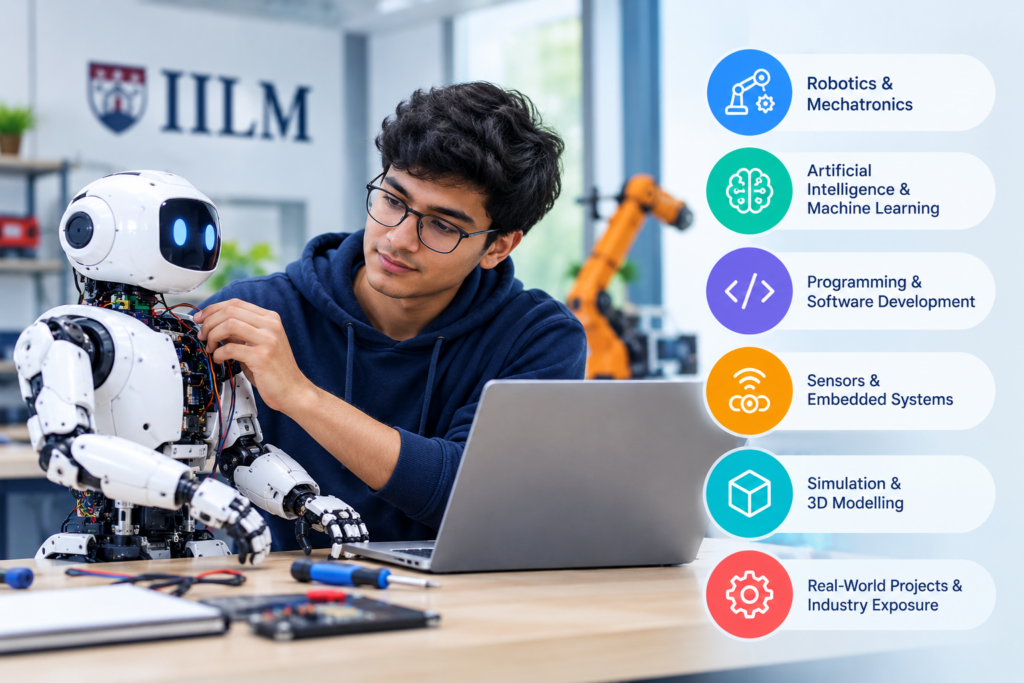
Quick Answer: B.Tech CSE with Robotic Intelligence at IILM University, Gurugram is a four year, UGC recognised engineering degree offered by the School of Computer Science and Engineering. It combines a core computer science foundation with robotics specific training in autonomous systems, sensors, and AI driven decision making, delivered with industry inputs from Addverb, a Reliance backed warehouse robotics company. Eligibility is a minimum 50% aggregate in 10+2, generally with Physics and Mathematics.
If you are trying to figure out what this program actually teaches, beyond the marketing language, here is the direct answer: it is a specialisation track within IILM’s B.Tech in Computer Science and Engineering at the Gurugram campus, not a separate mechanical engineering robotics degree. You spend the first two years building a standard CSE foundation, mathematics, programming, data structures, electronics, and then move into robotics specific coursework covering autonomous robot design, sensor integration, embedded systems, and AI for robotics, with the B Tech in Robotic Intelligence programme page listing the current course structure and eligibility criteria.
This matters because a lot of “robotics” branding in Indian engineering admissions is vague. This guide walks through exactly what the degree covers, what makes it different from IILM’s other robotics adjacent program at Greater Noida, who the industry partner actually is, and whether it fits your career goals.
What Is B.Tech CSE with Robotic Intelligence?
The programme sits inside the School of Computer Science and Engineering at IILM University’s Gurugram campus, not the mechanical or electronics engineering departments. According to the official programme page, it is designed for students who want to “gain expertise in designing, programming, and operating autonomous robots, integrating artificial intelligence for enhanced decision making and automation.” That framing is important: this is a computer science degree with a robotics specialisation, built around software, control logic, and AI, rather than a pure mechanical robotics program focused on hardware fabrication.
It runs for four years (48 months) as a full time, on campus program, and it is one of the specialisation tracks available under the broader B Tech in CSE umbrella at Gurugram, alongside tracks such as AI and Machine Learning, Cybersecurity, Cloud Computing, Data Science, and Generative AI.
Why This Kind of Program Exists Now
Robotics education is not being built on a hunch. India’s industrial robot installations reached a record 9,120 units in 2024, a 7% increase over the previous year, making India the sixth largest installer of industrial robots worldwide, according to the World Robotics 2025 report published by the International Federation of Robotics (IFR), the global industry body for robotics statistics. Automotive manufacturing drove much of this growth, with installations in that sector rising 15% in 2024. Globally, the same report recorded approximately 542,000 industrial robot installations in 2024, more than double the figure from a decade earlier.
That growth is exactly why an industry partner like Addverb matters for this specific program. Addverb Technologies is a Noida based robotics and warehouse automation company, majority owned by Reliance Retail since 2022, that builds autonomous mobile robots, automated storage and retrieval systems, and AI driven picking technology for clients including Amazon, PepsiCo, Coca Cola, and Flipkart. It is a genuine, large scale robotics employer, not a token logo, and its involvement gives students exposure to the kind of intralogistics and warehouse automation problems that are actually driving India’s robotics hiring right now.
Program Structure at a Glance
| Detail | Specification |
| Degree | Bachelor of Technology (B.Tech), Computer Science and Engineering, specialisation in Robotic Intelligence |
| Duration | 4 years, full time (48 months) |
| Campus | IILM University, Gurugram (Sector 53, Golf Course Road) |
| School | School of Computer Science and Engineering |
| Eligibility | Minimum 50% aggregate in 10+2 from a recognised board, generally with Physics and Mathematics as compulsory subjects |
| Curriculum framework | NEP 2020 aligned, with flexible credit structure and multiple entry and exit points |
| Key industry partner | Addverb Technologies (Robotics Intelligence specialisation) |
| Broader school partners | Microsoft, IBM, Xebia, L&T, AWS Academy, RedHat, Oracle, NEC, Intel |
Eligibility criteria can be revised between academic years, so it is worth confirming the exact current requirements on the Eligibility page before you apply, and checking current fee figures on the Fees Structure page rather than relying on third party aggregator estimates, which vary considerably.
What the Curriculum Actually Covers
Years 1 and 2: The Core CSE Foundation
Like every specialisation under IILM’s B.Tech CSE program, the first two years build the same underlying computer science base: programming fundamentals, data structures and algorithms, computer architecture, discrete mathematics, digital electronics, and database systems. This is deliberate. A robotics engineer who cannot write clean, efficient code, or who does not understand how a computer actually processes instructions, will struggle the moment robotics problems get complex. The specialisation tracks only begin to properly diverge from Year 2 onward.
Years 2 to 4: Robotics and AI Specific Coursework
Based on the specialisation electives published for IILM’s Robotics and Artificial Intelligence programs, coursework in this stream typically covers:
- Advanced Robotics Systems, covering the mechanical and control logic behind autonomous robot behaviour
- Artificial Intelligence for Robotics, applying machine learning to robot perception and decision making
- Sensor Fusion and Data Integration, combining inputs from multiple sensors into a single reliable picture for a robot to act on
- Embedded Systems Design, the hardware and firmware layer that connects software to physical actuators and motors
- Machine Learning for IoT, relevant where robots operate as part of a connected sensor network
- Cloud Computing for IoT, for robots that offload processing or coordination to the cloud
- Digital Twins and Simulation, letting students test robot behaviour in a virtual environment before deploying it physically
- Computer Vision, for robots that need to interpret camera input to navigate or manipulate objects
This list is drawn from the published elective structure for IILM’s Robotics and Artificial Intelligence course family, and specific course names and sequencing can shift between academic years, so treat it as a representative picture of the specialisation’s depth rather than a locked syllabus.
NEP 2020 Structure and Teaching Method
The School of Computer Science and Engineering runs its curriculum under the National Education Policy 2020 framework, which the Ministry of Education introduced in 2020 to modernise Indian higher education with more flexible, multidisciplinary study structures, as outlined in the Ministry’s own implementation update. In practice, at IILM this means:
- A flexible credit structure with multiple entry and exit points
- Compulsory ability enhancement, skill enhancement, and value added courses alongside the core engineering syllabus
- Mandatory internships built into the degree rather than left optional
- Teaching methods that include Outcome Based Education, Project Based Learning, an approach the school calls “Interleaving,” and pair programming exercises
Industry Partnership: What Addverb Actually Adds
A partnership only means something if it changes what students actually do, so it is worth being specific about what Addverb’s involvement looks like in practice, based on how the School of Computer Science and Engineering describes its industry collaborations: certification pathways, access to Addverb’s tools and frameworks as part of lab work, and exposure to real warehouse automation problem sets rather than only textbook robotics scenarios.
For context on what Addverb itself works on: the company operates a 15 acre manufacturing facility in Greater Noida producing autonomous mobile robots, automated storage and retrieval systems, and collaborative robots, and Reliance Retail’s 2022 investment in the company was explicitly framed around scaling automated warehouses across India’s retail and e-commerce sector. A student on this track is being trained, at least in part, toward the kind of intralogistics and warehouse robotics roles that this specific partner actually hires for, which is a narrower and more concrete outcome than “robotics” as a broad, undefined career category.
Labs, Competitions, and Hands On Learning
The School of Computer Science and Engineering runs eight specialised labs, including facilities for cognitive computing, cloud DevOps, and digital forensics, with hands on training tied to certifications from partners including RedHat, Oracle, and Addverb. Robotics specific hands on exposure at the school has included:
- Robo Race, an annual inter team robotics competition where student built robots navigate a narrow track under time and precision constraints, testing sensor calibration, motor coordination, and programming accuracy
- An active IEEE Student Branch, inaugurated under the School of Computer Science and Engineering, giving students access to technical conferences, competitions, and a global professional network relevant to robotics and electronics research
- Cross disciplinary events such as an AI Winter School covering AI and IoT integration, which feeds directly into the sensor and connected systems side of robotics coursework
Faculty and Research Context
The School of Computer Science and Engineering is led by Dr Shamik Tiwari, Professor and Dean, who has been named among the World’s Top 2% Scientists for three consecutive years, 2023, 2024, and 2025, in the Stanford University and Elsevier global scientist ranking. Faculty across the school hold PhDs from institutions including IIT Bombay and Aligarh Muslim University, and the school maintains a research collaboration with IIT Ropar’s Cyber Physical Systems research lab, which, while positioned primarily around the cybersecurity specialisation, reflects the kind of research grade infrastructure a robotics student can also draw on for interdisciplinary project work.
Eligibility and Admission Process
The published eligibility criteria for this programme are:
- Successful completion of 10+2 or an equivalent examination from a recognised board, State Board, CBSE, or CISCE, with a minimum aggregate of 50% marks
- Specific subject requirements, generally Physics and Mathematics as compulsory subjects for technical programmes, in line with standard AICTE norms for engineering admissions
Since subject and percentage requirements can be updated for each admission cycle, always cross check against the current Admissions Procedure page before finalising your application, and review the Scholarship page for merit based fee support if you qualify. If you are still comparing this against IILM’s other CSE specialisation tracks, the university’s own guide on B.Tech CSE specialisations and its eligibility and admission process walkthrough cover the practical steps in more detail.
Career Paths After B.Tech in Robotic Intelligence
Because this specialisation blends CSE, AI, and robotics engineering, graduates are positioned for roles across several adjacent fields rather than one narrow job title.
| Role | What it typically involves |
| Robotics Engineer | Designing and programming robot behaviour, integrating sensors and actuators |
| Automation Engineer | Building and maintaining automated systems in manufacturing or warehousing |
| AI and Robotics Developer | Applying machine learning models to robot perception and decision making |
| Embedded Systems Engineer | Working on the hardware and firmware layer connecting software to physical devices |
| Computer Vision Engineer | Building the visual perception systems robots use to navigate and manipulate objects |
| Research Associate (Robotics) | Supporting applied research in autonomous systems, often as a step toward an M.Tech or PhD |
Placement outcomes for this specific specialisation track were not independently available at the time of writing, since it sits within a broader B.Tech CSE cohort placed through IILM’s central placement process. For overall placement context and how IILM approaches recruiter relationships across its 400 plus company network, the Placements page carries the university’s own published data, and it is worth reading alongside a general, honest assessment of the degree, such as this breakdown of whether B.Tech CSE is still worth it in 2026.
How This Compares to IILM’s Other Robotics Program
IILM also runs a distinctly different robotics adjacent degree at its Greater Noida campus, under the Department of Mechanical and Allied Engineering rather than Computer Science and Engineering. It is worth understanding the difference before choosing.
| Feature | B.Tech CSE, Robotic Intelligence (Gurugram) | B.Tech, Robotics and Artificial Intelligence (Greater Noida) |
| Home department | School of Computer Science and Engineering | Department of Mechanical and Allied Engineering, School of Engineering |
| Core orientation | Software, AI, and control logic for robotics | Mechanical and applied engineering, with robotics and AI overlay |
| Specialisation options | Single robotics track within a broader CSE specialisation menu | Further sub specialisations in Internet of Things, Electric Vehicle Technology, and Drone Technology |
| Key industry partner | Addverb (warehouse and intralogistics robotics) | MOBEC Innovation (electric vehicle and battery systems), among others |
| Best fit for | Students who want to build the intelligence layer, software, AI, and perception, behind robots | Students who want deeper hands on work with the physical and electromechanical side of robotics, EVs, or drones |
Neither track is objectively better. The right choice depends on whether you are more drawn to writing the code that makes a robot think, or building and integrating the physical systems that make it move.
Is This Program Right for You?
This specialisation is likely to suit you if:
- You enjoy programming and want that skill applied to physical, moving systems rather than purely software products
- You are comfortable with a heavy first two years of core computer science before the specialisation content becomes prominent
- You are interested in warehouse automation, industrial robotics, or AI perception systems specifically, since the Addverb partnership skews the practical exposure in that direction
- You want a degree path that keeps M.Tech or research options open, since IILM’s Greater Noida campus also runs a dedicated M.Tech in Robotics and Machine Intelligence for students who want to continue into postgraduate robotics research
It is probably not the right fit if you are looking for a primarily mechanical or electromechanical robotics education, in which case the Greater Noida Robotics and Artificial Intelligence branch, with its Electric Vehicle and Drone Technology specialisations, is a closer match.
Frequently Asked Questions
Is B.Tech in Robotic Intelligence at IILM a separate degree from B.Tech CSE?
No. It is a specialisation track within the B.Tech in Computer Science and Engineering programme at IILM University, Gurugram, not a standalone robotics engineering degree.
What is the duration of the program?
Four years, or 48 months, delivered as a full time, on campus programme.
What is the eligibility criteria?
A minimum of 50% aggregate marks in 10+2 from a recognised board, generally with Physics and Mathematics as compulsory subjects for technical admission. Confirm the current year’s exact criteria on the official Eligibility page.
Does this program involve building physical robots, or is it mostly software?
It is weighted toward software, AI, and control logic, though the curriculum does include embedded systems and sensor integration coursework, and hands on events like Robo Race give students physical robot building experience. Students who want a primarily hardware and mechanical robotics education may find IILM’s Greater Noida Robotics and Artificial Intelligence branch a closer fit.
Who is Addverb, and why does the partnership matter?
Addverb Technologies is a Noida based robotics and warehouse automation company, majority owned by Reliance Retail since 2022, that builds autonomous mobile robots and automated storage systems for clients including Amazon and Flipkart. The partnership gives students exposure to real intralogistics automation problems and industry aligned certifications.
What jobs can graduates expect?
Roles typically include robotics engineer, automation engineer, embedded systems engineer, AI and robotics developer, and computer vision engineer, largely in manufacturing, warehousing, and automation focused technology companies.
Is robotics a growing field in India right now?
Yes. India recorded a record 9,120 industrial robot installations in 2024, a 7% year on year increase, ranking sixth globally in annual installations, according to the International Federation of Robotics’ World Robotics 2025 report.
Bottom Line
B.Tech CSE with Robotic Intelligence at IILM Gurugram is best understood as a computer science degree with a robotics and AI specialisation layered on top, not a mechanical robotics program. The first two years build a standard CSE foundation, and the specialisation depth, autonomous systems, sensor fusion, embedded systems, and AI for robotics, comes through from the second year onward, backed by an industry partnership with Addverb that is genuinely relevant to where India’s robotics hiring is actually growing. It suits students who want to build the intelligence and software layer behind robots rather than the physical hardware itself, and it sits within a real, current growth market rather than a speculative one. If the mechanical and electromechanical side of robotics interests you more, IILM’s Greater Noida Robotics and Artificial Intelligence programme, with its Electric Vehicle and Drone Technology tracks, is worth comparing before you decide. Either way, confirm the current year’s eligibility, fees, and specialisation availability directly through the B.Tech CSE admissions page before applyin