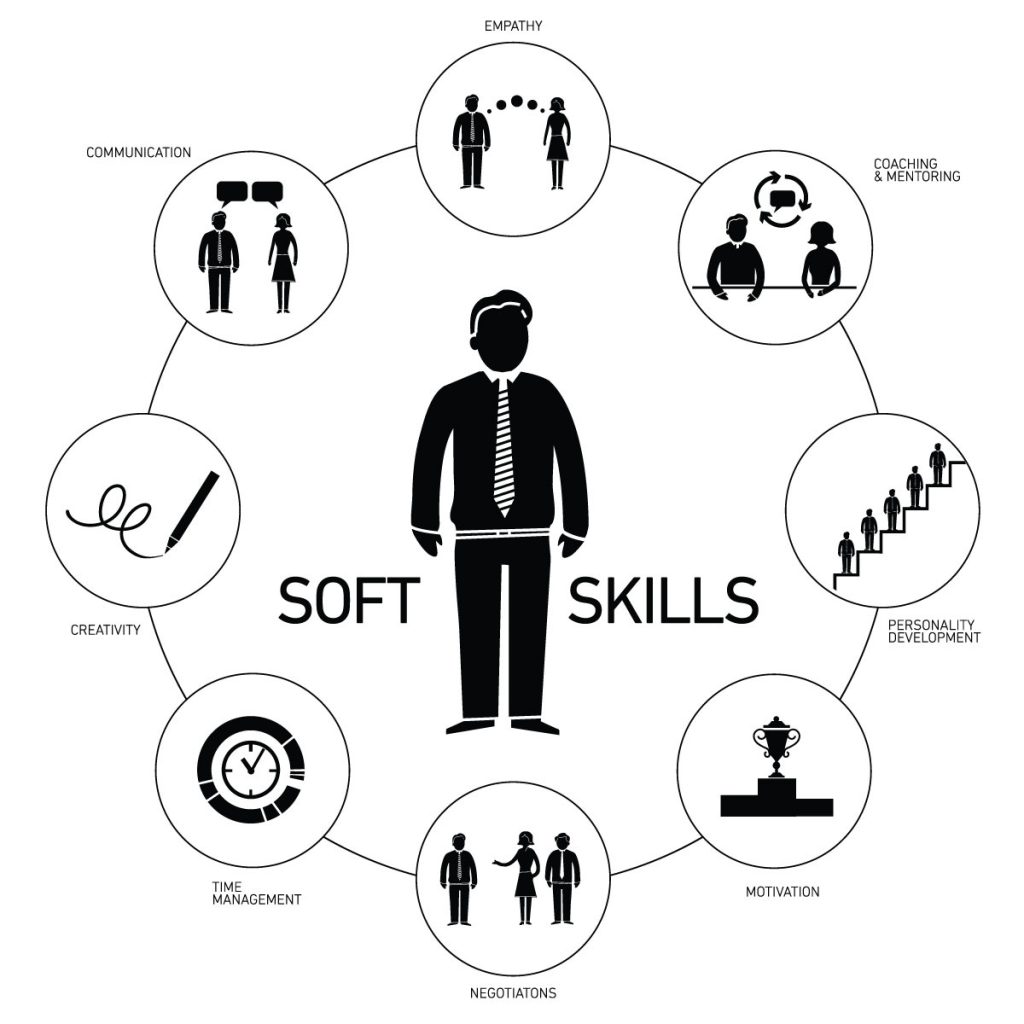
Soft skills are the behavioural and interpersonal abilities that determine how effectively you work, communicate, and lead in a classroom, a job interview, or a boardroom. They are not technical abilities that can be learned from a textbook in a semester. They are built through experience, self-awareness, deliberate practice, and feedback over time.
If hard skills get you an interview, soft skills get you the job and decide how far you go once you are in it. A 2026 LinkedIn Workforce Report found that 92% of talent professionals and hiring managers say that soft skills are equally or more important than technical skills when making hiring decisions. The World Economic Forum’s Future of Jobs Report 2025 lists communication, critical thinking, and leadership among the top skills employers will prioritise in the next five years.
This guide covers what soft skills are, the top 10 every student needs, how they differ from hard skills, actionable ways to develop each one, and why MBA and engineering students need them specifically.
LinkedIn Global Talent Trends Report (cited as 92% figure — verify current version at business.linkedin.com/talent-solutions/global-talent-trends). World Economic Forum Future of Jobs Report 2025 (weforum.org).
What Are Soft Skills? A Clear Definition
Soft skills are non-technical, interpersonal, and behavioural attributes that affect how an individual communicates, collaborates, leads, solves problems, and manages themselves and others in professional and social environments. They are sometimes called ‘people skills’, ‘interpersonal skills’, or ‘transferable skills’, all pointing to the same core idea: how you work with others, not just what technical work you can do.
Unlike hard skills, which are role-specific (Python for a software engineer, financial modelling for a finance analyst), soft skills are universally relevant. A surgeon, a marketing manager, and a mechanical engineer all need communication. A consultant, a teacher, and an entrepreneur all need leadership and problem-solving. This universality is what makes soft skills the highest-return investment a student can make in their professional development.
Soft skills fall into two broad categories: personal attributes (how you manage yourself, time management, resilience, self-awareness, creativity) and interpersonal attributes (how you work with others, communication, empathy, leadership, conflict resolution).
Top 10 Soft Skills Every Student Must Have in 2026
These are the soft skills most consistently cited by employers, recruiters, and graduate outcome studies as decisive for career success. Each skill is defined, its workplace significance explained, and specific development actions provided.
1. Communication Skills
What it means: The ability to express ideas clearly and confidently in writing, speaking, and listening across different audiences, media, and contexts. This includes written communication (emails, reports, proposals), verbal communication (presentations, meetings, interviews), and active listening.
Why it matters: Every professional role requires communication. In management roles, it determines whether the strategy is understood and executed. In engineering, it determines whether technical requirements are clearly documented and whether problems get escalated before they become crises. Poor communication is the most commonly cited reason for project failure and workplace conflict.
How to develop it: Practise speaking on unfamiliar topics for 2 minutes daily, record yourself and review. Write one short piece of structured communication each week (an email, a summary, a proposal). Join a debate club, a MUN (Model United Nations) group, or a public speaking society. Get feedback from people who will be honest rather than polite.
2. Emotional Intelligence (EQ)
What it means: The ability to recognise, understand, and manage your own emotions and to perceive and influence the emotions of others. The four components of emotional intelligence are: self-awareness, self-regulation, social awareness (empathy), and relationship management.
Why it matters: EQ predicts leadership effectiveness more reliably than IQ in most managerial contexts. Leaders with high EQ navigate conflict constructively, build teams that trust them, and maintain performance under pressure. In client-facing roles, EQ determines whether relationships are built or lost.
How to develop it: Keep a reflection journal, write 3 sentences about a professional or social interaction each day: what happened, how you felt, what you would do differently. Practice naming your emotions specifically, rather than just ‘stressed’ or ‘annoyed’. Emotional vocabulary is the foundation of self-awareness. Seek feedback from peers on how you come across in group situations.
3. Critical Thinking and Problem Solving
What it means: The ability to analyse a problem objectively, consider multiple perspectives, identify assumptions, evaluate evidence, and arrive at a reasoned conclusion or course of action. This is distinct from general intelligence; it is a disciplined mental process that can be practised and improved.
Why it matters: Every workplace, from a startup to a DRDO research lab to a Big 4 consulting firm, requires people who can structure ambiguous problems, not just execute defined tasks. As AI handles more routine work, the premium on genuinely analytical human thinking increases.
How to develop it: Practise case studies even if you are not in a management programme. Read one economics or business analysis article per day and try to identify its central assumption and one flaw in its reasoning. Play logic puzzles or structured reasoning games. When you encounter a problem, write down the problem statement, your initial hypothesis, three alternative explanations, and then evidence for and against each before reaching a conclusion.
4. Leadership
What it means: The ability to influence, motivate, and guide others toward a shared goal without necessarily having formal authority. Leadership is demonstrated through initiative (starting things), direction (setting a course when ambiguity exists), and follow-through (keeping teams on track).
Why it matters: Every organisation needs people who take ownership. Leadership is not restricted to managers; a junior engineer who identifies a problem and drives the team toward a solution is demonstrating leadership. Employers consistently say they want graduates who take initiative rather than wait to be told.
How to develop it: Lead something, a student club, a college event, a group project, a community initiative. The scale is less important than the responsibility. Volunteer to facilitate rather than participate. Debrief after every leadership experience: what worked, what did not, what you will do differently.
5. Teamwork and Collaboration
What it means: The ability to work effectively with diverse groups of people, contributing your skills, supporting others’ contributions, managing disagreement constructively, and keeping the shared goal in view when individual preferences conflict.
Why it matters: No significant professional outcome is achieved alone. MBA projects, engineering deliverables, consulting engagements, and startup launches all require teams. Employers do not just want people who can do their individual tasks; they want people who make the team around them more effective.
How to develop it: Actively choose team roles that stretch you. If you typically lead, try being a contributor; if you typically stay quiet, volunteer to present. After team projects, have a structured debrief: what did we do well, what conflicted, what would we do differently? This reflection converts team experience into genuine skill.
6. Adaptability and Resilience
What it means: Adaptability is the ability to adjust effectively to new circumstances, unexpected changes, and different environments without losing performance quality. Resilience is the ability to recover from setbacks, failures, and criticism without shutting down.
Why it matters: In an environment where job roles, industry structures, and technology stacks change rapidly, adaptability is a survival skill. The World Economic Forum consistently lists it among the top ten skills for the future of work. Resilience matters because every career includes failure, and the differentiator is not the absence of setbacks, but the speed of recovery.
How to develop it: Deliberately place yourself in unfamiliar situations, join a club unrelated to your discipline, take a course in a subject you find difficult, travel to environments where you are not the default. Practice reframing setbacks: write down what a difficult experience taught you, not just what went wrong.
7. Time Management
What it means: The ability to allocate your time intentionally across tasks, projects, and commitments, prioritising what matters, meeting deadlines, and maintaining quality without chronic overload.
Why it matters: Students who cannot manage time in college become professionals who miss deadlines, underdeliver, and burn out. Time management is not about being busy; it is about being productive with the time available.
How to develop it: Use time blocking: assign specific tasks to specific time slots in your calendar rather than maintaining a to-do list. Practice the ‘eat the frog’ principle: do the most important, most difficult task first each day. Review your actual time use weekly against your planned allocation. The gap between planned and actual is where time leaks.
8. Work Ethic and Professionalism
What it means: Consistency, reliability, punctuality, accountability, and the willingness to do what is required without needing external motivation every time. Professionalism also includes how you present yourself, how you handle disagreement, and how you treat people with less power or status than you.
Why it matters: Hard skills determine what you can do. Work ethic determines how reliably you do it. Employers consistently say that attitude and work ethic are among the most important factors in long-term career success and the most difficult to train after hiring.
How to develop it: Hold yourself to the same standards in low-stakes situations (assignments, college meetings, informal commitments) as you would in high-stakes ones. Professionalism is a habit; it cannot be switched on for job interviews and switched off everywhere else.
9. Creativity and Innovation
What it means: The ability to generate new ideas, approaches, and solutions and to apply existing knowledge in novel contexts. Creativity is not limited to artistic disciplines; it applies equally to product design, business strategy, engineering problem-solving, and legal argumentation.
Why it matters: As AI automates pattern recognition and rule-following tasks, genuinely creative thinking, finding solutions that have not been tried, and combining ideas from different domains become more valuable, not less. Companies specifically look for people who can think beyond established procedures.
How to develop it: Practice lateral thinking exercises. Read across disciplines, a management student who reads neuroscience or architecture brings connections that pure management reading cannot produce. Participate in hackathons, design challenges, or case competition ideation rounds. Maintain an ‘idea journal’, write one idea per day, no matter how unpolished.
10. Networking and Relationship Building
What it means: The ability to build genuine, mutually beneficial professional relationships, not the transactional collecting of contacts, but the sustained development of a network that gives and receives value over time.
Why it matters: Research consistently shows that most opportunities, internships, job offers, business introductions, and career pivots come through relationships, not cold applications. Your network is a long-term professional asset that compounds over decades.
How to develop it: The foundation of networking is giving before asking, sharing information, making introductions, offer help before you need anything. Attend industry events, alumni meets, and guest lectures with the intention of having one genuinely interesting conversation, not collecting business cards. Follow up within 48 hours with something specific, a reference from the conversation, or an article related to what was discussed.
Soft Skills vs Hard Skills — Key Differences
The most common confusion about soft skills is treating them as the ‘nice to have’ category and hard skills as the ‘necessary’ category. This misunderstands how careers actually develop.
| Soft Skills | Hard Skills | |
| Definition | Interpersonal, behavioural, and character traits that affect how you work and relate to others | Technical, measurable abilities specific to a job, task, or industry |
| Examples | Communication, leadership, emotional intelligence, problem solving, adaptability, teamwork | Python programming, financial modelling, AutoCAD, data analysis, accounting, legal drafting |
| How acquired | Through experience, practice, feedback, self-awareness, and structured development programmes | Through formal education, training, certification, and hands-on technical practice |
| How measured | Observed through behaviour — interview performance, team dynamics, client feedback | Tested directly — examinations, certifications, portfolio, and technical assessments |
| Transferability | Highly transferable — communication and leadership matter in every industry and role | Often industry-specific or role-specific, Java is less useful in an audit firm. |
| Career impact | Determines career progression beyond entry level — leadership, promotions, client relationships | Determines entry-level hire and technical credibility in early career |
| The recruiter’s view | Hard skills get you an interview. Soft skills get you the job — and keep you growing in it. | Essential for shortlisting but insufficient for selection alone in most management and leadership roles |
The practical implication: invest in both, but understand that hard skills determine your entry point and soft skills determine your ceiling. Two engineers with identical technical abilities will diverge dramatically in career trajectory based on communication, leadership, and emotional intelligence over a 10-year period.
How to Develop Soft Skills as a Student — Actionable Framework
Soft skills are not developed by reading about them. They are developed through deliberate practice in real situations, followed by honest reflection. Here is a framework that works in a college environment.
Step 1: Diagnose — Know Your Starting Point
Ask three people who know you professionally (a professor, a classmate who has worked with you on a project, an internship supervisor) to give you honest feedback on your communication, leadership, and teamwork. The gap between how you think you come across and how others experience you is the most useful data you can have.
Step 2: Choose One Skill Per Semester to Focus On
Trying to develop ten skills simultaneously produces shallow progress in all of them. Choose one skill per semester: communication in Semester 3, critical thinking in Semester 4 and immerse yourself in developing that skill specifically. One skill developed deeply is worth more than ten touched superficially.
Step 3: Create Structured Practice Opportunities
- Communication: Join a debate club, Model UN, or public speaking society. Volunteer to present in every group project. Write one structured piece per week.
- Leadership: Take on a responsible role in a student club as treasurer, event head, or secretary, not just membership. Lead at least one project end-to-end per semester.
- Emotional intelligence: Keep a daily reflection journal (3 sentences) on significant interactions. Ask for feedback after high-stakes group situations.
- Problem-solving: Practice case studies weekly. Use the MECE (Mutually Exclusive, Collectively Exhaustive) framework to structure your analysis of any complex problem.
- Networking: Attend at least one industry event per month. Follow up with one new contact per event within 48 hours.
Step 4: Review and Adjust Every 90 Days
At the end of every semester, ask for specific feedback from the same three people you consulted at the start. Has the feedback changed? What is the new gap? Adjust your next semester’s focus accordingly. This 90-day review cycle converts intention into measurable development.
Soft Skills for MBA and Engineering Students Specifically
Different academic tracks demand different soft skill emphases — not because other skills are unimportant, but because the immediate application contexts vary.
| Soft Skill | For MBA Students | For Engineering Students |
| Communication | Client presentations, case study delivery, stakeholder management in business contexts | Technical documentation, requirement briefings, and explaining engineering decisions to non-technical stakeholders |
| Leadership | Leading project teams, managing cross-functional MBA cohort projects, and improving group discussion performance | Leading development sprints, coordinating technical teams, and mentoring junior engineers |
| Emotional Intelligence | Client empathy, managing organisational dynamics, reading negotiation rooms | Team conflict resolution, receiving critical feedback on code or design, and maintaining composure under project pressure |
| Problem Solving | Structured business case analysis, consulting frameworks, and root cause identification in strategy | Debugging, system design, and troubleshooting — structured analytical thinking under time pressure |
| Adaptability | Pivoting between case study domains, adjusting to different client industries in consulting. | Learning new technology stacks, adapting to changing project requirements, and cross-functional problem exposure |
MBA students: Group Discussions (GDs) in MBA admission processes are a direct assessment of communication, critical thinking, and teamwork under pressure simultaneously. The MBA classroom, with its case method and cross-functional projects, is itself a soft skill development environment if engaged seriously. The Corporate Readiness Programme at IILM University specifically builds communication, professional presence, and leadership as core components of MBA readiness, not as add-ons, but as a curriculum.
Engineering students: The most common limitation of technically strong engineering graduates is their inability to communicate technical work to non-technical stakeholders, managers, clients, and cross-functional teams. Engineers who can write a clear problem statement, explain a technical decision in plain language, and lead a project team are the engineers who reach senior and management roles. Soft skills are not a soft addition to an engineering education; they are the multiplier that converts technical depth into career impact.
IILM Corporate Readiness Programme (CRP): iilm.edu/greater-noida/mba/ (Phase 1: aptitude, communication, and soft skills training — confirmed); apply.iilm.edu/mba-pgdm-2026/ (Mindset, Skillset, Toolset; Phase 2 and 3 by industry experts — confirmed).
How IILM University Builds Soft Skills
At IILM University, soft skill development is a structured, credit-bearing component of the academic programme, not an optional workshop or a one-day seminar at the end of Year 2.
Corporate Readiness Programme (CRP): A six-credit programme running across all four semesters of the MBA, delivered in three phases. Phase 1 builds aptitude, communication, and soft skills. Phase 2 focuses on professional presence, AI-driven CV building, profile mapping, and functional skill boot camps. Phase 3 covers mock Group Discussions, Personal Interview training, and role-specific preparation by industry experts from recruiting companies. The CRP is not optional and is not crammed into the final semester; it runs as a continuous development process across the programme.
Centre for Emotional Intelligence: IILM University’s dedicated Centre for Emotional Intelligence conducts research, EI assessments, workshops, and personal coaching for students, faculty, and corporate organisations. The Centre focuses on self-awareness, emotion regulation, and relationship management, the foundational components of EQ that most university curricula do not address systematically.
Courses across programmes: Communication Skills, Emotional Intelligence, Intergroup Relations, and Personality Growth and Development are offered as courses across IILM programmes, providing structured academic engagement with soft skills development in addition to the CRP.
Centre for Purposeful Work and student clubs: IILM Gurugram’s School of Management includes the Centre for Purposeful Work, the Centre for Innovation and Entrepreneurship, and a mix of domain-specific and cultural clubs, all structured to give students real responsibility for running events, managing teams, and building professional relationships during their degree.
CRP: iilm.edu/greater-noida/mba/ (6 credits, Semesters 1-4, Board Infinity and Career Carve delivery, three phases confirmed); apply.iilm.edu/mba-pgdm-2026/ (Phase 2 and 3 by recruiting company experts confirmed); iilm.edu/gurugram/placements/ (Know Yourself module, Mindset/Skillset/Toolset, hyper-personalised CRP confirmed). Centre for Emotional Intelligence: iilm.edu/centre-for-emotional-intelligence/ (EI assessment, workshops, coaching, research confirmed). Courses: iilm.edu/blog/relevance-soft-skills-personality-development-among-students/ (original post — Communication Skills, EI, Intergroup Relations, Personality Development confirmed). Centre for Purposeful Work and Innovation: iilm.edu/gurugram/school-of-management/ (confirmed).
▶ Explore MBA programmes at IILM University: iilm.edu/mba
▶ IILM Centre for Emotional Intelligence: iilm.edu/centre-for-emotional-intelligence
Frequently Asked Questions
What are examples of soft skills?
Soft skills include: communication (both written and spoken), emotional intelligence, critical thinking and problem solving, leadership, teamwork and collaboration, adaptability, time management, work ethic and professionalism, creativity, and networking. Other commonly cited soft skills include empathy, conflict resolution, active listening, self-motivation, and cross-cultural awareness. These are ‘people skills’ or ‘interpersonal skills’ abilities that determine how effectively you work with others, manage yourself, and navigate professional environments. They apply across every industry and role.
Why are soft skills important for career growth?
Soft skills determine career growth beyond entry level in a way that hard skills alone cannot. Technical skills get you hired; soft skills determine how far you advance. A 2026 LinkedIn Workforce Report found that 92% of talent professionals consider soft skills equally or more important than hard skills for hiring decisions. The reason is structural: as you advance in any career, your work increasingly involves managing people, influencing stakeholders, solving ambiguous problems, and building relationships, all of which require soft skills. Two people with identical technical qualifications will diverge in career trajectory based almost entirely on communication, leadership, and emotional intelligence.
Can soft skills be taught in college?
Yes, with the right structure. Soft skills cannot be taught through lectures alone, but they can be systematically developed through deliberate practice, structured feedback, and real-world application. The most effective approaches combine classroom learning (courses on communication, EI, leadership theory) with experiential application (student clubs, case competitions, internships, mentoring) and structured feedback mechanisms. At IILM University, the Corporate Readiness Programme and Centre for Emotional Intelligence are designed around exactly this principle. Soft skill development is treated as a credit-bearing, programmatic process, not a workshop that happens once.
What is the difference between soft skills and interpersonal skills?
Interpersonal skills are a subset of soft skills, which specifically cover how you relate to and work with other people. Communication, empathy, teamwork, conflict resolution, networking, and active listening are interpersonal skills. Soft skills are the broader category, which includes both interpersonal abilities and personal attributes, the qualities that affect how you manage yourself: time management, resilience, creativity, work ethic, and self-awareness. All interpersonal skills are soft skills, but not all soft skills are interpersonal. A scientist who works alone but manages their time well, adapts to setbacks, and produces creative research is demonstrating soft skills even with minimal interpersonal interaction.
Which soft skill is most important for placements?
Communication is consistently ranked as the most important soft skill for placements because it is assessed directly at every stage of the hiring process: resume writing (written communication), Group Discussion (oral communication and active listening), and Personal Interview (both). After communication, emotional intelligence and problem-solving are the next most frequently cited by recruiters. For Group Discussions, specifically those that are part of MBA entrance processes and campus recruitment at most major companies, the ability to listen actively, build on others’ points, and articulate structured views under time pressure is the skill that most directly determines selection.